The Moses Curve: How AI is Splitting Talent Performance Distribution
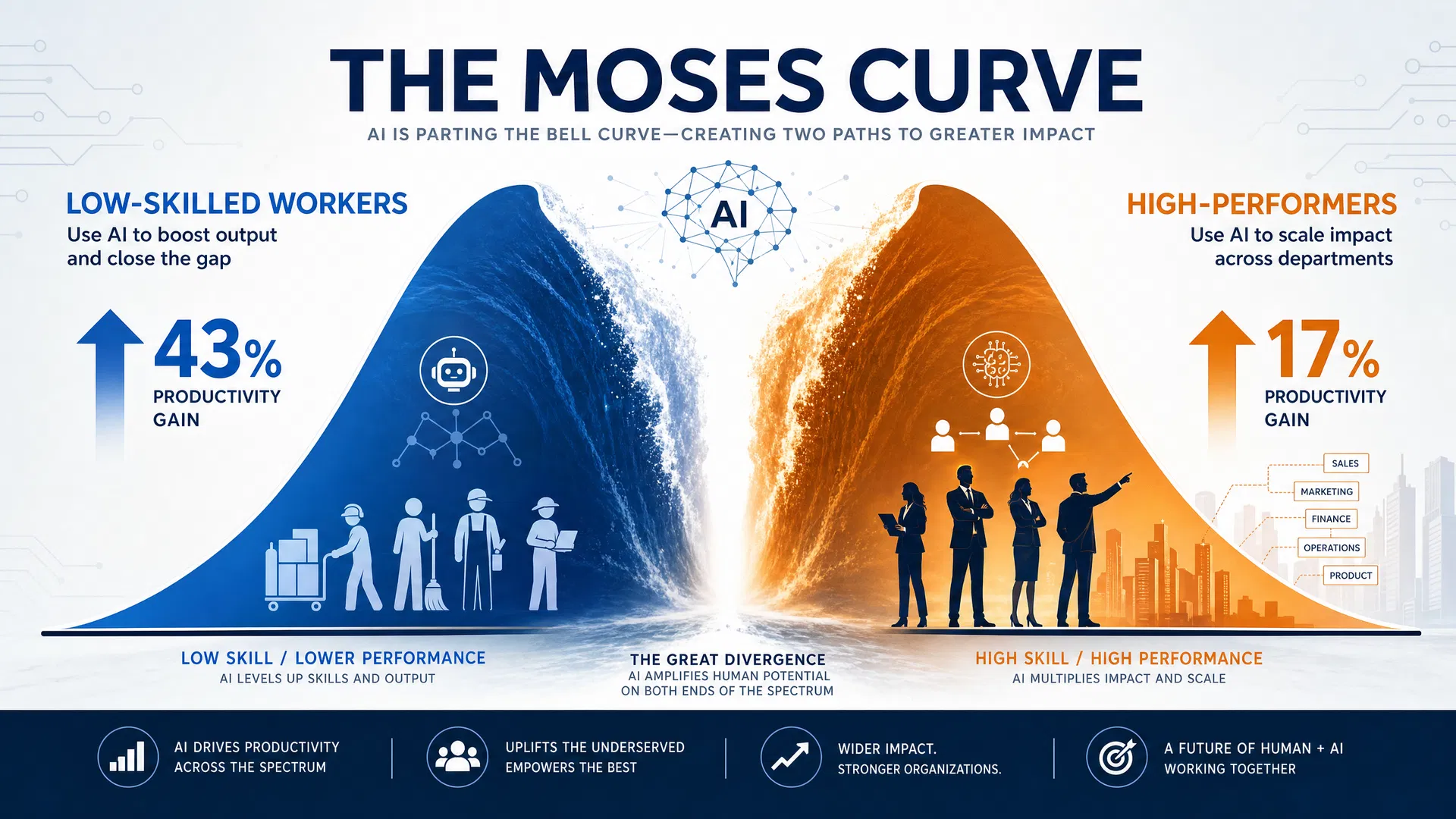
Imagine standing at the edge of the Red Sea as Moses raises his staff. The waters part, creating two distinct paths forward—one for those on the left, one for those on the right. Today, artificial intelligence is doing something similar to the talent performance distribution curve. It's splitting it down the middle, creating two diverging paths for workers at opposite ends of the skill spectrum.
But here's the paradox that challenges conventional wisdom: the workers with the most to gain from AI adoption—low performers—are simultaneously the least equipped to leverage it strategically. Meanwhile, high performers, who gain less percentage-wise, are compounding their advantages into something approaching superhuman productivity.
This is the Moses Curve—and it's reshaping the future of work in ways that most organizations haven't yet recognized.
Part 1: The Data Behind the Split
Recent research from MIT Sloan reveals something striking. When lower-skilled workers use GPT-4 to complete knowledge work tasks, their productivity jumps by 43% compared to their baseline performance. For a data analyst struggling with complex SQL queries, a customer service representative crafting nuanced responses, or a junior consultant building a business case—AI becomes a force multiplier that nearly doubles their output.
Now consider the highly skilled worker—the top 10% performer in their field. The same MIT Sloan research shows they gain only 17% from using GPT-4 on similar tasks. But this number obscures a critical detail: it only applies when AI is used within its capabilities. The moment highly skilled workers push AI outside its boundaries, their performance actually drops by an average of 19 percentage points.
Part 2: The Income Inequality Mechanism
Brookings Institution research paints a sobering picture about AI's current impact on income inequality. When researchers mapped AI productivity exposure against worker income across the entire U.S. economy, they found something unexpected: AI exposure peaks at approximately $90,000 annual salary and remains high for six-figure earners.
Why? Because today's most advanced AI systems are primarily accessed through three channels: chatbots, APIs, and specialized software. All three require one thing: you must do your work primarily at a computer. This immediately excludes vast swaths of the workforce—agricultural workers, electricians, plumbers, nurses, construction workers, and countless service industry professionals.
Part 3: The Superstar Effect
Here's where the Moses Curve becomes truly consequential. The 43% productivity gain for low performers sounds impressive until you understand how high performers are using AI.
A high performer doesn't just use AI to do their existing job 17% faster. They use AI to automate entire workflows that previously required a team, delegate to AI tasks that would have required junior staff, compress project timelines from months to weeks, and expand scope without proportional effort increases.
The 17% productivity gain is just the baseline. The real advantage comes from compounding: using AI to eliminate bottlenecks, automate support tasks, and focus entirely on high-value work.
Part 4: The Incentive Paradox
This is the critical insight that most commentary on AI misses: the workers with the greatest incentive to adopt AI are the least equipped to leverage it strategically, while those with the greatest ability to leverage it have the least immediate incentive.
A low performer faces a simple calculation: "If I use AI, I get 43% better. That's a massive improvement to my output and job security." But a 43% improvement to mediocre work is still mediocre work.
A high performer faces a different calculation: "If I use AI, I get 17% better at my current work. But I can also use AI to do the work of my entire team." The incentive isn't just personal productivity—it's strategic leverage.
Part 5: Will This Level the Playing Field?
The short answer is no—and the research suggests it might actually widen the gap.
There are legitimate reasons to hope AI could reduce inequality: democratized access to best practices, lowered skill barriers, and compressed learning curves. But the evidence increasingly points to widening gaps: strategic use requires expertise, access inequality favors high earners, compounding advantages for high performers, capital vs. labor shift, and the expertise premium.
Part 6: What This Means for Your Career and Organization
For individual workers: if you're a low performer, adopt AI immediately but use it as a stepping stone to develop deeper expertise. If you're a high performer, invest time in mastering AI as a strategic tool. For everyone, the window for "adopting AI" is narrowing. The real competitive advantage now goes to those who've moved beyond adoption to mastery.
For organizations: don't assume AI will level your organization's performance. It won't. It will amplify existing differences. Your best people will become superhuman. Your weakest people will improve but remain weak. Invest in high-performer development, create AI-augmented workflows, develop AI literacy, and rethink role design.
We're at an inflection point. The talent performance distribution curve is splitting like Moses parting the Red Sea. The question isn't whether this will happen—it's already happening. The question is: which side of the curve will your organization be on?